The End of the Marty Peretz Era
At a controversial event at the Center for Jewish History, Trump donor Bill Ackman held his own against an exhausted brand of liberalism.
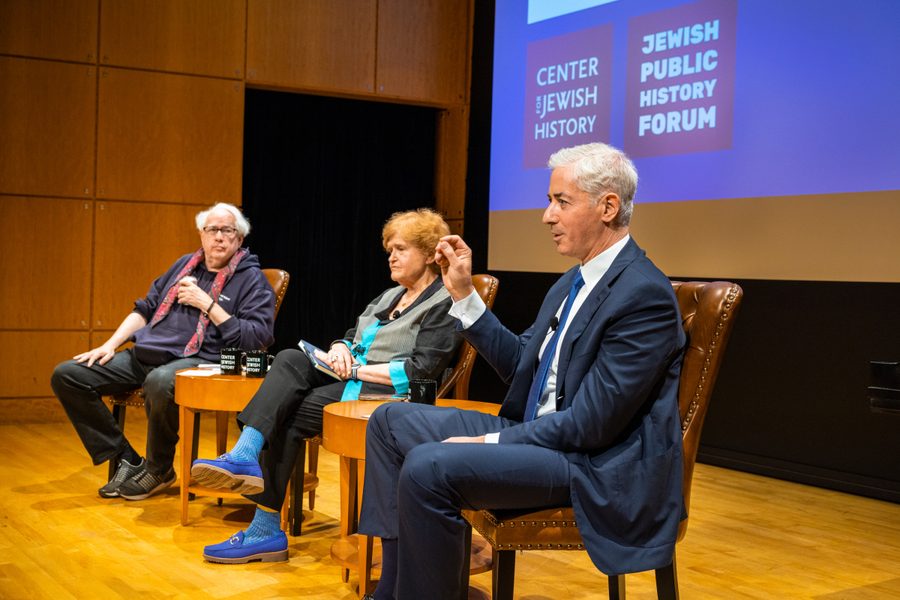
Leon Wieseltier, Deborah Lipstadt, and Bill Ackman at the Center for Jewish History in Manhattan on May 18th, 2025.
In 1974, a 35-year-old Harvard lecturer named Marty Peretz purchased The New Republic (TNR) with $380,000 of his wife’s inherited sewing machine fortune and commenced remaking the magazine in his image. Though he came up on the activist New Left in the 1960s, Peretz had since fallen out with many of his erstwhile comrades over Israel, particularly its rejection by Black radicals. He soon fired the incumbent editor, overhauled the masthead, and made it TNR’s mission to challenge liberal pieties and, as he later wrote in his memoir, “argue for why Zionism mattered.”
For nearly 40 years, TNR—often referred to as “the in-flight magazine of Air Force One” during the Clinton presidency, in recognition of its influence in Washington—reflected Peretz’s priorities. Though it always positioned itself as left of center, the magazine often staked out controversial stances on both foreign and domestic policy that aligned it more with neoconservatism. It championed the Nicaraguan contras during the Reagan era, helped kill the Clinton administration’s universal health care plan, published Charles Murray’s inquiry into racial disparities in IQ, and led the liberal drumbeat to invade Iraq in 2003—all while consistently defending Israel’s actions, from its bloody intervention in the Lebanese civil war to its repression of Palestinians during the First and Second Intifadas. Countless notables built their early careers there—among them policymakers like Samantha Power and Antony Blinken and pundits like Jonathan Chait, Andrew Sullivan, and Jewish Currents editor-at-large Peter Beinart. But the magazine’s credibility began declining in the early 2000s, as Peretz’s hawkish centrist liberalism fell out of favor in the wake of the Iraq disaster. His own reputation plummeted in parallel; for instance, he was made persona non grata at Harvard after activists protested his numerous racist remarks about Black people and Arabs. Financial troubles at TNR eventually forced Peretz to sell to Facebook co-founder Chris Hughes, whose editorial mismanagement triggered an exodus of the remaining Peretz-era staff before he sold to current owner Win McCormack; under both Hughes and McCormack, the magazine has repudiated much of Peretz’s editorial line and generally tacked left. “I am a dissatisfied man,” Peretz reflected in 2023, as he contemplated not only his personal failures but the collapse of his ideological project.
Peretz has mostly kept a low profile in recent years, but earlier this month, he resurfaced as the organizer of a conference at the Center for Jewish History (CJH) in Manhattan titled “The End of an Era? Jews and Elite Universities.” The program immediately drew fire over one of its keynote panelists, Bill Ackman, a hedge fund billionaire and longtime benefactor of both Peretz’s TNR and CJH, who has recently gained notoriety as a ferocious critic of campus pro-Palestine activism. As of this writing, 86 scholars have signed an open letter to CJH condemning the institution for the event’s “overall lack of academic expertise on Jews and higher education” and contending that “the lineup of speakers . . . endangers the Center’s reputation for academic excellence and integrity.” The letter singles out Ackman for supporting the Trump administration’s assault on higher education, which has “threatened academic freedom, the secure employment of academic workers, and scholars’ right to free speech.”
Despite these objections, the day-long conference proceeded without disruption on Sunday, May 18th, before a disproportionately elderly audience. Of the 17 speakers, 12 of whom were men and all of whom were Jewish, over half were former contributors to Peretz-era TNR. These included the magazine’s longtime literary editor, Leon Wieseltier—who has rebounded from his 2017 sexual harassment scandal, and has run the journal Liberties for the past five years—along with academics like Paul Berman, Steven Pinker, and Nicholas Lemann, and journalists like Jamie Kirchick and Eli Lake. The lineup suggested a reunion, or perhaps a resuscitation, of an intellectual community that hasn’t properly existed in more than a decade.
Peretz himself kicked off the event with an address that highlighted, above any substantive point about the day’s subject, his own frailty. “I’m 102, and next year I’ll be 101,” the 86-year-old quipped, before admitting that he had no prepared notes and had forgotten what he wanted to say. After several painful minutes spent slowly recalling the Columbia University uprising of 1968 and forgetting which participants he intended to thank, Peretz acknowledged his own embarrassment—“but hey, I am, as I said, 103”—and passed the podium to Rabbi David Wolpe, who opened his more cogent remarks by praising Peretz for his “ageless accomplishment” at TNR. It was the first of many such tributes: University of Maryland historian Jeffrey Herf said that without Peretz’s TNR, “there’s a hole in our political culture that still needs to be filled”; Kirchick thanked Peretz and Wieseltier for giving him “the graduate education I did not ever have”; and Ackman, who had been Peretz’s student at Harvard in the 1980s, simply said, “I’m here because of Marty Peretz.”
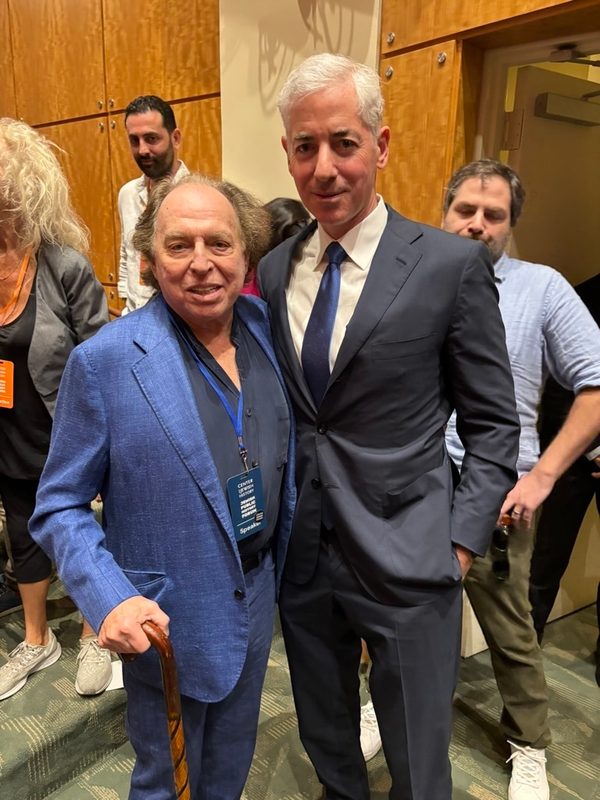
Marty Peretz and Bill Ackman at the Center for Jewish History.
A valedictory tone permeated the day. It wasn’t just that Peretz’s disciples wanted to honor him in the face of his acknowledged decline; many of the panelists seemed to feel that the “golden age” of American Jewish life, as TNR alum Franklin Foer wrote last year, might also be slipping into the past. Multiple participants recounted the familiar story of how Jews overcame antisemitic quotas at the Ivies to ascend into the upper echelons of American society, and there was much anxious discussion of recent Jewish demographic decline at elite universities (between 1967 and 2023, the Jewish share of undergraduates shrank by around half at Columbia, Yale, and Harvard, though Jews remain significantly overrepresented at all three relative to their share of the US population). These fears of dwindling Jewish representation in the corridors of power are concurrent with fears about the long-term health of liberalism—at least as many American Jews have long defined it, with an assumed degree of liberal sympathy for Israel regardless of its political behavior. Squeezed between allegedly antisemitic protests and Donald Trump’s draconian crackdown in response, the academic and intellectual era that had shaped so many of these panelists appeared, indeed, to be ending.
Against the backdrop of Israel’s daily bombardment of Palestinian civilians, the panelists were overwhelmingly concerned with the Jewish student experience closer to home. Though there was some light dissent—NYU journalism professor Susie Linfield described the response to incidents of campus antisemitism as a “moral panic,” while the Harvard cognitive psychologist Steven Pinker dismissed assertions of widespread antisemitism as “Harvard derangement syndrome”—the general consensus from the stage was that elite university campuses are increasingly hostile spaces for Jews. Deborah Lipstadt, the Holocaust historian and Joe Biden’s special envoy to monitor and combat antisemitism, said she’s “met too many students” considering college options who are asking “where will I be comfortable as a Jew?” As for currently enrolled undergraduates, she said she’s “met students who haven’t been harassed but they’re moving their mezuzahs from outside their dorm rooms to inside, for safety’s sake” and is aware of others “who are wearing baseball caps instead of yarmulkes”—a phenomenon she described as “Jews going back into the closet.” Journalism professor and New Yorker staff writer Nicholas Lemann said he had lost friends over his role as co-chair of Columbia’s post-October 7th joint task force on combating antisemitism, and recounted arguing with campus activists who refuse to understand how central Zionism is to many Jews’ identity. He choked up briefly, saying that the lack of “empathy” shown by such activists “provides a platform for the utter dismissal of the kind of Jews my kids are,” drawing sympathetic applause.
If Lemann was at least theoretically interested in trying to engage critics of Zionism, other panelists seemed to hold such critics in visceral contempt. Most egregiously, both Ackman and Lipstadt seemed to float the conspiracy theory that student protesters coordinated with Hamas and had advance knowledge of the October 7th attacks. “This wasn’t an organic protest,” said Lipstadt. “There was a lot of preparation before 10/7.” “There’s a lot of evidence that our foreign adversaries are funding many of the protests,” Ackman said, before insisting that activist groups should be required to disclose their funding sources.
Few panelists acknowledged more than glancingly the underlying context for campus protests: Israel’s ongoing genocidal campaign against the Palestinians of Gaza. Both Linfield and Pinker alluded to the suffering of Palestinians, but cast it as a kind of abstract moral fixation by idealistic demonstrators rather than a matter of sincere concern. Wieseltier was the only panelist who seemed to appreciate why the actual events in Gaza have been galvanizing for so many students. “Anybody who does not understand why a Palestinian or a sympathizer would get unhinged by what happened in Gaza is not paying attention,” he said, to scattered applause. “You may believe the Israeli war is just, as I do, but the magnitude of the carnage in Gaza is such that there is a certain moral integrity to protesting it.” He cited his own experience as a teenage member of Meir Kahane’s Jewish Defense League in 1960s Brooklyn to put student activism in context. “When I was a bright young Jewish fascist, I said things I cannot bear to remember,” he said. “These are kids and they say virulent things, and they’re not going to hurt anybody.”
But despite these differences, all of the panelists—with the notable exception of Ackman—seemed in broad agreement that Trump’s campus crackdown has gone too far. Lipstadt, who acknowledged that she has “been skewered for saying that some of the initial actions taken by the Trump administration were things Jewish students had been asking for,” expressed concern that Jews will now be blamed for the president’s overreach. Rachel Gordan, a scholar-in-residence at CJH, noted that the University of Florida, where she teaches, has already experienced something like Trump’s campus crackdown for the past several years, thanks to the “repression and fear on campus that many have compared to the McCarthy era” under Gov. Ron DeSantis. “I don’t think Jews are having a bad experience at UF as Jews,” said Gordan. “The real crisis is a changing relationship between government and universities.”
While most panelists affirmed their support for First Amendment protections even of speech they disagree with, there was some exploration of precisely what counts as speech, as opposed to actions that might warrant deportation of foreign students. Eli Lake, the neoconservative journalist who is currently a columnist for Bari Weiss’s Free Press, said that while he questioned why the imprisoned grad student activist Mahmoud Khalil was admitted to Columbia and “despised” his rhetoric, “you can’t just assert that you can deport him without telling us the actual crime he’s accused of when he’s a permanent resident and he has a green card.” Linfield, a self-described “free speech absolutist,” agreed, but said “we are in dangerous territory when we don’t draw a distinction between protected speech and illegal actions like defacing or taking over administration buildings.” Kirchick articulated most clearly how he thought these issues should be arbitrated: “Foreign citizens have the right to protest here; what they don’t have the right to do is break the law. If they’re just out there demonstrating peacefully, holding up signs, and chanting slogans, it doesn’t matter if I like them or not, that’s legally protected speech. If they are involved in taking over campus buildings, defacing property, or harassing individual students or professors, then not only should they be expelled, they should be deported.”
Lake and Kirchick both reflected on the relationship between free speech and what they regard as the suffocating culture of wokeness in higher ed, as embodied by diversity, equity, and inclusion (DEI) policies that have been targeted by Trump and that right-wing critics see as fostering a climate in which expression is effectively stifled. Lake noted that offensive speech against groups other than Jews is routinely disciplined on elite campuses. “If the rules are rigged against Jews, that itself is a problem,” he said. “The way to resolve this is to get rid of DEI and fire all the DEI instructors,” said Kirchick. “It’s good to call out the hypocrisy, but we shouldn’t want to add the Jews to this group of protected people.” In a preview of Ackman’s remarks, which blamed campus antisemitism on the “ideology of intersectionality,” Kirchick suggested a link between “radical transgender movements” and anti-Israel attitudes, warning that a society that will believe “that men can become women and women can become men . . . will believe anything.” “The crazier those people are, the more anti-Israel they are,” said Kirchick, who is openly gay, regarding queer, trans, and nonbinary people. “The more letters you add to your identity, the higher a building they’ll throw you off in Gaza City,” he added, to audience laughter. “I don’t know if that’s antisemitism—antisemitism has to be a part of it, but it’s something much deeper and more disturbing and sicker.”
Such comments went unchallenged; for most of the day, debate was kept to a minimum. The most contentious panel was the keynote, for which attendees paid a premium, featuring Ackman, Lipstadt, and Wieseltier. It fell to Ackman, an outlier at the event, to unequivocally defend the Trump administration’s strategy of withholding federal research dollars as a means of responding to the alleged threat of campus antisemitism. The billionaire made the case that Trump’s blackmail is in fact a legitimate negotiating tactic aimed at “making Harvard more of a meritocracy,” and that elite private universities are not entitled to taxpayer money unless they conform to Ackman’s particular definition of academic freedom, which precludes any support for DEI or for teaching Palestinian perspectives. Citing Harvard’s motto, “Veritas,” Ackman argued that his alma mater has replaced truth with “social transformation” and now aims to teach the next generation of leaders that “there’s a bicameral world of oppressors and oppressed,” a framework “that is very similar to Marxism.” “This has been going on for 30 years,” scoffed Wieseltier, a seasoned veteran of campus culture wars. “You may have come late to this ideology.” Ackman and Wieseltier went back and forth for the rest of the event, both drawing cheers from sections of the audience, while Lipstadt sat between them, both physically and ideologically. While the two men staked out clear disagreements on the proper relationship between universities and government, Wieseltier rounded out the discussion on a conciliatory note. “I want to thank my friends Deborah and Bill,” he said. “Against certain enemies, we will all march together.”
In the reception area at the event, where attendees noshed between panels on kosher salmon reubens and cookies frosted in the blue and white of the Israeli flag, Marty Peretz’s 2023 memoir, The Controversialist, was on sale alongside other panelist-authored books. In one chapter, Peretz describes how New York City, where he grew up in an intellectually vibrant, Yiddish-speaking milieu during and after World War II, had by the 1970s and ’80s become a city for financiers. “I didn’t come to New York for intellectuals anymore,” he writes of visiting his hometown from Cambridge. “My new friends were in finance, and I met them through my work for Israel and for Jewish cultural institutions.” It’s in this context that Peretz became close with figures like Michael Steinhardt, who helped pioneer a shift in the Jewish donor ecosystem from investment banks to hedge funds such as Pershing Square Holdings, founded by Bill Ackman in 2004. It was Ackman who formed a consortium with several other wealthy donors to keep Peretz’s TNR afloat until it could be sold, and Ackman who was a major donor to the Martin Peretz Undergraduate Research Fund that was supposed to be established at Harvard in 2010, before Peretz became a lightning rod for his racist blog posts.
“The America we came up in was one of neighborhoods and ethnicities and creeds and unions; the America we helped grow, the one we have now, is one of PhDs and interstate systems and investment portfolios,” Peretz writes—a wistful reflection near the end of his long and consequential life. Perhaps PhDs are becoming relics of an older America too, but investment portfolios do rule America now, including America’s Jewish cultural institutions. And though Ackman faced criticism over his defense of Trump’s war on higher ed, no one was impolite enough to state outright the likeliest reason why Ackman was appearing onstage in the first place: In addition to the significant financial support he has provided CJH, including raising more than $30 million to retire the center’s construction debts in the 2010s and co-chairing the center’s board for several years, his subject matter expertise amounts to his influence with the Trump administration and among Harvard and Columbia trustees, bought by his $9.3 billion fortune.
It was all too appropriate that Ackman dominated Peretz’s event, because Ackman is Peretz’s most relevant legacy today. As an undergraduate, Ackman’s sensibility was shaped by attending Peretz’s Harvard lectures and reading TNR, from which he absorbed not a commitment to abstract liberal values, but a compulsion to defend the Jews against all perceived communal threats. What Peretz’s TNR represented at its height to many of the other panelists—a robust, confident establishment that saw no tension or contradiction between its liberal and Zionist ideals—has become as exhausted as Peretz himself appeared to be. A March Gallup poll of Americans showed that sympathy for Israel vis-a-vis Palestinians has fallen below 50% since the October 7th attacks, with a particularly stark drop among Democrats. For many people, it is becoming untenable to reconcile core liberal commitments with the reality of Israel’s starvation campaign in Gaza, not to mention the Trump administration’s lawless arrests of campus dissidents who speak out against it. Meanwhile, the unapologetic authoritarianism Ackman supports—which, it turns out, is not so far removed from the unapologetic Zionism Peretz’s TNR represented for decades—is thriving.
When it comes to addressing this crisis, most of the prominent social critics whose careers Peretz helped foster are at a loss, especially because their work has little appeal to the current occupants of the White House. Ackman may have been the least intellectually distinguished person onstage at the CJH event, but he has by far the most access to actual power in America in 2025. “Foreign students were a relatively small percentage of the [Harvard] class when I attended. Now they’re a much larger percentage,” Ackman complained at one point, “so the number of Americans being served to become leaders of our society is a tiny fraction.” As if on cue, just four days after the event, the Trump administration announced a total ban on foreign students at Harvard.

I’m Peter Beinart, editor-at-large of Jewish Currents. Before you go, I need to ask something of you.
In recent years, I’ve watched as mainstream Jewish institutions and media have chosen ethnonationalism over liberal democracy and mass slaughter over the pursuit of a just peace. Jewish Currents offers something different. It’s a magazine built on intellectual curiosity and respect for the dignity of all people.
But a project like this doesn’t sustain itself, and we can’t do it without your help. If you share my belief in the importance of this mission, please consider making a donation—or even better, a recurring one. We need you with us.

David Klion is a contributing editor at Jewish Currents, a columnist at The Nation, and a writer for various publications. He is working on a book about the legacy of neoconservatism.